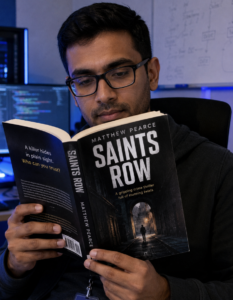
IT consultants live in a world of hidden problems. A server goes down, a workflow breaks, a client insists “nothing changed,” and yet somewhere beneath the surface there is always a cause. The best IT consultants do not simply fix what is obvious. They trace patterns, question assumptions, dig through messy histories, and look for the one buried detail everyone else missed.
That is exactly why Saint’s Row feels like the kind of murder mystery novel an IT consultant would not be able to put down.
At first glance, Saint’s Row is a dark, atmospheric mystery centered around a ritual murder in a dying church. But beneath that opening crime is something much larger: a broken system, a town full of hidden dependencies, and a long chain of secrets protected by silence. For IT consultants who spend their days investigating digital chaos, broken processes, failed implementations, cyber risks, and human error, Saint’s Row reads like a case file they would instinctively want to solve.
This is not just another whodunit. It is a layered mystery about systems, corruption, hidden records, institutional failure, and the dangerous things people build when no one is allowed to ask the right questions. That makes it one of the best murder mystery books for IT consultants who enjoy stories that require more than casual reading. 🔎
Why IT Consultants Think Like Mystery Readers
The connection between IT consulting and murder mystery fiction is stronger than most people realize. IT consultants are professional problem-solvers. Their job is to walk into complicated environments, evaluate incomplete information, identify weak points, and figure out why something is not working the way it should.
A good mystery novel demands the same kind of thinking.
In Saint’s Row, investigator Mathias Green enters a town where the official explanation is not enough. The murder of Pastor Gideon Vale should reveal one killer, but instead it exposes a larger system of control, fear, and hidden damage. That kind of layered investigation will feel familiar to consultants who know the first visible symptom is rarely the real issue.
In technology, a failed login may point to a permissions problem, a network issue, a misconfigured identity provider, or a deeper security concern. In Saint’s Row, one staged body points to a church, a town, buried records, falsified deaths, secret confinement, and generations of silence. The appeal is the same: the reader is not just watching a crime get solved. The reader is watching a system get debugged.
That is why readers who follow information technology consulting will likely recognize the mindset immediately. The consultant’s instinct is to look past what people say happened and investigate what the evidence proves happened.
Saint’s Row Is Built Like a Broken System
Every IT consultant has seen a broken system held together by habit. The company says the process works, but no one can explain why. The software still runs, but only because everyone has learned how to work around its failures. The documentation is outdated, the permissions are messy, and the people who built it are no longer around to answer questions.
Saint’s Row has that same feeling, except the system is not a piece of software. It is an entire town.
The story centers on Saint’s Row, Louisiana, where Mathias Green investigates a brutal death that quickly becomes bigger than one crime scene. The town closes ranks. People protect old secrets. Records matter. Silence becomes infrastructure. The church is not just a setting; it is part of the machinery that has shaped the town’s fear, obedience, and moral confusion.
That is what makes the novel so compelling for IT consultants. Consultants are trained to understand that systems are never only technical. Every system has users, incentives, gatekeepers, shortcuts, and hidden risks. A bad system can survive for years because people are afraid to challenge it. A toxic process can become normal simply because everyone has learned to live inside it.
In the same way, Saint’s Row shows how a town can become trapped inside its own corrupted architecture. The mystery is not only about who committed a murder. It is about who benefited from the system, who protected it, and who suffered because of it.
The Debugging Mindset Makes the Story More Addictive
IT consultants do not read mysteries passively. They investigate as they go.
They notice inconsistencies. They question motives. They mentally organize clues. They ask why a person would behave a certain way, why a record would disappear, why a town would protect a lie, and why one death would reveal so many other buried failures.
That is where Saint’s Row becomes especially satisfying. The novel gives readers a mystery that behaves like a complex troubleshooting ticket. The first issue opens another issue. The second issue exposes a deeper dependency. The deeper dependency reveals a system no one wanted documented.
IT leaders today are constantly being reminded that modern technology problems are increasingly interconnected. CIO’s coverage of major challenges IT leaders face points to the importance of coordinated strategy, data, governance, cybersecurity, and measurable results. That same logic applies to a strong mystery: every clue matters because every clue is connected to a larger structure.
In Saint’s Row, Mathias Green must read the town the way a consultant reads an environment. What is visible? What is missing? Who has access? Who benefits from confusion? What has been intentionally buried? What process keeps repeating even though it harms people?
That investigative rhythm makes the novel incredibly easy for IT consultants to keep turning pages. It rewards pattern recognition, skepticism, and the willingness to look underneath the surface.
The Novel Speaks to Consultants Who Understand Risk
IT consulting is not just about technology. It is about risk. Consultants help businesses understand what could go wrong, what already has gone wrong, and what will keep going wrong unless someone finally fixes the root cause.
Saint’s Row is a mystery built on the consequences of ignored risk.
The town’s secrets did not appear overnight. They grew because people looked away. They remained because people normalized the abnormal. They survived because the truth was inconvenient, dangerous, or too costly to admit. For consultants, that theme lands hard because many business failures follow a similar pattern. Warnings are missed. Documentation is ignored. Security gaps are minimized. Old systems are trusted long after they should have been replaced.
CISA’s guidance on cyber threats and response reminds organizations that hidden vulnerabilities can create serious consequences when they are not addressed. While Saint’s Row is fiction, its emotional logic is very real: hidden problems do not stay hidden forever. Eventually, they surface.
That is one reason the novel works so well for readers in IT consulting. It understands that the past is never really gone. Old decisions remain inside the system. Bad architecture leaves evidence. Buried records still matter. A cover-up is just another kind of corrupted database, waiting for the right person to query it.
Mathias Green Feels Like the Investigator IT Consultants Want to Follow
A strong mystery depends on a strong investigator, and Mathias Green brings the kind of calm, analytical persistence that consultants will appreciate. He does not accept the easiest answer. He does not let the town’s silence end the investigation. He keeps pushing because he understands that truth is usually layered.
That makes him a compelling character for readers who enjoy intelligence-driven mysteries. He is not simply chasing a suspect. He is examining a whole environment. He understands symbols, motives, institutional behavior, and the damage caused when authority is abused.
IT consultants may see a familiar professional discipline in that approach. The best consultants do not barge into a client’s business and assume they know everything. They listen, observe, test, document, and investigate. They look for the difference between what leadership believes is happening and what the system actually proves.
That is the kind of tension Saint’s Row delivers. The town has its own story about itself. Mathias has to find the truth underneath that story.
Why This Mystery Fits the Modern IT Consultant’s World
The IT consulting world is growing more complex. Businesses are investing heavily in IT services, software, AI, cloud systems, cybersecurity, and digital transformation. CIO Dive reported on global tech spending and the role of IT services, showing how central technology services have become to modern business strategy.
But complexity also creates fatigue. IT consultants are constantly surrounded by urgent tickets, client expectations, shifting tools, security concerns, and nonstop change. Sometimes, the perfect book is one that uses the same investigative muscles but pulls the reader into a completely different world.
Saint’s Row does exactly that.
It gives IT consultants a mystery that feels familiar in structure but fresh in setting. Instead of a broken network, there is a broken town. Instead of a missing configuration file, there are buried records. Instead of a failed process, there is a generations-long system of silence. Instead of a postmortem meeting, there is a murder investigation that forces the truth into the open.
For consultants who enjoy stories with depth, tension, atmosphere, and psychological weight, Saint’s Row is the kind of novel that turns reading into a full mental investigation.
The Human Side of Systems Failure
One of the most powerful parts of Saint’s Row is that it does not treat the mystery as a puzzle only. It also treats it as a human tragedy. At the center of the story is Judah Mercy, a boy who stopped speaking after seeing too much. That detail gives the novel emotional weight beyond the mechanics of the crime.
IT consultants know systems affect people. A bad implementation can frustrate employees. A security failure can expose customers. A broken workflow can damage trust. A poorly managed technology environment can create stress, confusion, and real business consequences.
CompTIA’s Tech Jobs Report tracks the technology workforce and employer demand, but behind every technical role are real people trying to solve real problems. Saint’s Row understands that same truth in a darker fictional setting. Systems are never just systems. They shape lives.
That is why the novel’s mystery feels bigger than solving a case. Mathias is not only trying to expose what happened. He is trying to stop a machine that has hurt people for too long.
A Smart Read for Consultants Who Like Dark, Layered Fiction
Saint’s Row belongs on the reading list of IT consultants who enjoy intelligent fiction with atmosphere, tension, and moral complexity. It is especially appealing for readers who like Southern Gothic settings, psychological suspense, institutional secrets, and mysteries where every answer leads to a deeper question.
It is not a light, cozy mystery. It is darker, more intense, and more layered. That is part of its strength. The novel invites readers to think, investigate, question, and keep digging until the hidden structure is revealed.
For IT consultants, that makes it more than entertainment. It becomes a story that mirrors the way they already see the world: every system tells a story, every failure has a cause, and every hidden problem leaves a trace.
Conclusion
The Murder Mystery Novel IT Consultants Won’t Be Able to Stop Debugging: Saint’s Row is more than a catchy title. It is an accurate description of how this book pulls the reader in.
Saint’s Row gives IT consultants the kind of mystery their minds are built to chase. It has hidden records, institutional failure, corrupted systems, buried truth, and a central investigator who refuses to accept the surface-level explanation. It is atmospheric, intelligent, unsettling, and deeply connected to the kind of pattern-based thinking consultants use every day.
For readers who spend their professional lives solving problems, untangling systems, and finding the root cause behind the visible failure, Saint’s Row offers a murder mystery that feels almost impossible not to investigate.
Some novels are read. This one gets debugged. 💻